Multi-City Depositions: Scheduling, Custody, and Rule 30 Controls
A fictional five-city federal-deposition scenario with a decision matrix, ownership chart, custody controls, and failure playbook.
Hypothetical planning case study
This is a fictional planning scenario for counsel. It does not describe an actual Caption Legal engagement, client, matter, or outcome, and it does not promise a result or service. It is a workflow exercise designed to help a litigation team separate federal procedural questions from practical record-production decisions.
The scenario: one federal case, five locations, one record plan
Assume a commercial case is pending in federal court. Over six business days, counsel must take five oral depositions: a Rule 30(b)(6) designee in Chicago, a former employee in Denver, a third-party vendor witness in Atlanta, an expert in Boston, and a rebuttal witness appearing remotely from Seattle. The examining team is in New York; opposing counsel and one interpreter will join remotely for portions of the schedule. Counsel expect to use selected testimony in dispositive-motion briefing and may seek video excerpts at trial.
Each session has a legal layer—notice, officer, oath, recording, objections, stipulations, and later use—and a production layer—room confirmation, media movement, transcript labels, and final-version control. Begin with a factual assumptions memorandum identifying the governing court and orders, witness location, officer and oath plan, recording method, notice details, language or access needs, exhibit handling, and delivery dates. A reliable file name does not cure an improper notice, and the memorandum does not represent terms the parties have not accepted.
Rule baseline: decide the legal questions before the logistics
Officer, oath, and location
For a deposition within the United States, Federal Rule of Civil Procedure 28(a) requires an officer authorized to administer oaths by federal law or by the law in the place of examination, or a person appointed by the court where the action is pending. Rule 28(c) also disqualifies an officer who is a party’s relative, employee, or attorney; related to or employed by a party’s attorney; or financially interested in the action. In a multi-city series, that means counsel should identify the place of examination and vet the proposed officer for each session rather than assuming that one vendor arrangement resolves every location’s authorization question.
Rule 30(b)(5) provides that, unless the parties stipulate otherwise, the officer begins the deposition with identifying information, including the officer’s name and business address, the date, time, and place, the deponent’s name, administration of the oath or affirmation, and the identities of persons present. The officer must record the testimony by the method designated under Rule 30(b)(3)(A). Rule 30(f)(1) requires the officer to certify in writing that the witness was duly sworn and that the record accurately records the testimony. If the team proposes a remote or hybrid format, confirm the forum’s controlling orders and the parties’ agreement or court order concerning how the oath and officer requirements will be satisfied. Do not treat a platform’s “record” button as proof that those requirements were met.
Notice, recording, and time limits
Rule 30(b)(1) requires reasonable written notice stating the time and place of the deposition and, if known, the deponent’s name and address. Rule 30(b)(2) permits documents or tangible things to be designated for production at the deposition. Under Rule 30(b)(3)(A), the notice must state the method for recording testimony; unless the court orders otherwise, testimony may be recorded by audio, audiovisual, or stenographic means, and the noticing party bears the recording costs. A party may designate another recording method with prior notice under Rule 30(b)(3)(B), bearing the added expense unless the court orders otherwise.
Rule 30(d)(1) generally limits a deposition to one day of seven hours, absent stipulation or court order, and instructs courts to allow additional time consistent with Rule 26(b)(1) and (2) when needed for fair examination or where the deponent or another circumstance impedes examination. Build the schedule around the actual location’s local time, planned breaks, interpreter cadence, and a hard stop. A calendar invitation set in the examining lawyer’s time zone is not a substitute for a notice stating a clear time and place.
Stipulations and use later in the case
Rule 29 allows parties, unless the court orders otherwise, to stipulate to deposition procedure, including taking a deposition before any person, at any time or place, on any notice, and in the manner specified; it also allows stipulations about other procedures governing or limiting discovery. A stipulation that would interfere with time set for completing discovery, for hearing a motion, or for trial may be made only with court approval. Put operational agreements in a dated writing, identify the case and witness, and state precisely what is being changed. Preserve objections and reservation-of-rights language where counsel intends to preserve it.
Rule 32 governs use of depositions in court proceedings. It permits all or part of a deposition against a party who was present or represented at the taking or had reasonable notice, subject to the rule’s conditions and the Federal Rules of Evidence. Rule 32(a)(4) lists circumstances in which a witness deposition may be used for any purpose, including death, distance of more than 100 miles from the place of hearing or trial (unless the absence was procured by the offering party), age, illness, infirmity, imprisonment, or exceptional circumstances. It does not make every clip automatically admissible. Build an index that preserves objections, designations, errata if any, and the original context needed for later Rule 32 and evidence analysis.
A decision matrix for the series
Use a matrix at the kickoff meeting, then freeze its legal fields when the notice and any stipulation are finalized. “Recommendation” below means an operational choice, not a Federal Rule requirement. The responsible attorney should resolve deviations under the governing rules, local practice, and any case-specific order.
| Session | Procedural questions to resolve | Production recommendation | Release condition |
|---|---|---|---|
| Chicago 30(b)(6) | Notice topics; place; officer authorization; recording method | In-room exhibit operator and a topic-to-exhibit index | Attorney confirms topic list and final exhibit set |
| Denver former employee | Notice; subpoena or party-witness status; oath/officer; video designation | Capture room, witness, and remote-participant checks in a session log | Officer certificate and native media receipt logged |
| Atlanta third party | Subpoena compliance; notice; local examination details; interpreter need | Pre-number and reconcile exhibits at close | Producing counsel verifies return of originals |
| Boston expert | Notice; seven-hour plan; recording method; materials designation | Time-box technical rehearsal and preserve screen-share identifiers | Lead counsel clears materials for distribution |
| Seattle remote rebuttal | Remote procedure; witness location; officer/oath; stipulated terms or order | Document connection test, backup contact, and interruption protocol | Attorney confirms record resumed after any disruption |
Responsibility chart: one owner, one escalation path
Assign each role to a named person and immediate escalation contact before notices issue. The deposition coordinator may manage logistics but should escalate legal questions to designated counsel.
- Lead deposition counsel: approves strategy, notices, stipulations, significant schedule changes, exhibit use, and the legal disposition of an interruption or irregularity.
- Deposition coordinator: maintains the master schedule, time-zone conversion, attendee list, confirmations, room information, and escalation contacts.
- Record officer/court reporter: performs the officer’s required record-making and certification duties under the applicable rules and arrangement, and reports any interruption or concern through the agreed channel.
- Video or media custodian: records receipt, transfer, hashes if used by the team, storage location, and delivery status. This is a production role; it does not certify the legal sufficiency of the deposition.
- Exhibit custodian: maintains the exhibit register, source file, production identifier, admitted/marked status, and disposition of physical originals.
- Accessibility and language coordinator: confirms requested accommodations, interpreter logistics, contact details, and the communication path for problems.
- Quality-control reviewer: compares deliverables to the order, checks completeness and legibility, and documents exceptions for attorney review.
Scheduling across cities without creating avoidable ambiguity
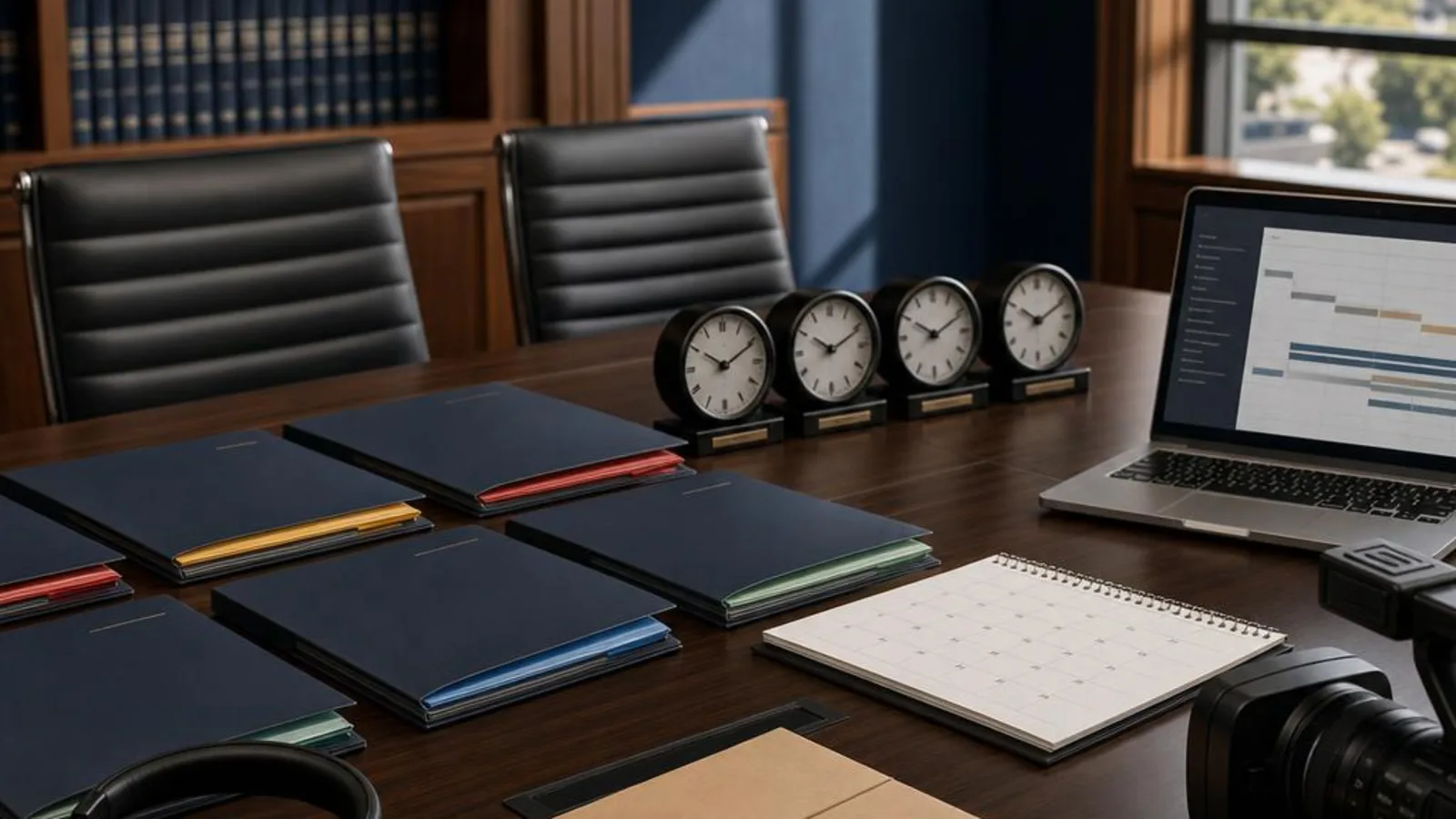
List every session in the location’s local time and with an IANA time-zone name or UTC offset in internal planning materials. Daylight-saving transitions make city abbreviations alone risky. The formal notice should state the time and place clearly; do not rely on a calendar attachment to supply a missing detail. For remote participants, circulate a separate logistics sheet that identifies the witness’s physical location, the officer’s contact information, the platform access method, phone backup, and the escalation contact to use before announcing a technical problem on the record.
Schedule a short technical check before each remote or hybrid session. It should test audio paths, witness camera framing, exhibit display, interpreter channels if applicable, and a backup connection. If a connection fails, suspend examination, preserve the time and recording status, confer as appropriate, and state the resolution on the record when the session resumes. Preserve the incident log with the production record; let counsel decide whether any corrective action, stipulation, or motion is warranted.
Exhibits, interpreters, and accessibility
Exhibit control
Create an exhibit register before the first deposition. Include proposed number, short description, source or production range, file name, format, confidentiality designation, premarked status, presentation status, and final marked status. The witness should see the same version that becomes the record. For a remote display, preserve the exact presented file or a reproducible copy, not merely a later re-export with the same title. If an exhibit changes during preparation, issue a new version rather than overwriting the earlier file.
Physical originals need a separate custody entry: who received the item, when, where it was stored, whether it was marked, and who returned or retained it. Digital custody records should identify the sending account or repository, receipt time, recipient, immutable source location where available, and any transformation such as redaction, OCR, or compression. Chain-of-custody documentation helps the team explain handling; it does not itself establish admissibility or authentication.
Language and access planning
Ask early whether a witness needs an interpreter or an accommodation. Confirm the language or communication need, format preferences, attendance method, breaks, and whether materials must be available in an accessible form. Give the interpreter and accessibility coordinator the deposition schedule and a controlled, authorized exhibit set only as needed. Counsel should determine on the record how the interpreter is identified and how interpretation will proceed. Do not ask an interpreter, technician, or coordinator to resolve substantive objections or make a legal ruling.
Naming, versioning, custody, and quality control
A consistent protocol makes it possible to locate the authoritative item months later. Use a matter code that does not expose unnecessary sensitive information, a YYYY-MM-DD date, witness identifier, city or remote-location tag, asset type, and a version suffix. For example: MATTER-042_2026-10-14_Witness-A_Chicago_Transcript_CERT_v01.pdf. Keep the case caption and sensitive identifiers out of filenames when a shorter controlled code will do.
Reserve v01, v02, and so on for working revisions. Use status labels separately: Draft (working document), Review, Final delivered, and Superseded. Never rename a revised file as though it were the original. Maintain a manifest that links every final item to its source file, creator or receiving party, date, storage location, and any checksum the team chooses to use. Restrict access according to the protective order, client policy, and the team’s confidentiality obligations.
QC should occur in stages: intake verifies that expected files arrived; technical QC checks playability, duration, audio, image, and exhibit readability; record QC reconciles session date, witness spelling, transcript label, certificate, and exhibit numbers; legal QC is counsel’s review of substantive completeness, confidentiality designations, redactions, and intended use. Log defects and their disposition. Do not silently replace an item after delivery; issue a corrected version, identify the reason, and notify the recipients who received the prior version.
Delivery package and failure playbook
Deliver through the authorized case repository or other approved channel, with a manifest and explicit recipient list. The delivery message should say what is included, its status, any known limitation, and who must confirm receipt. Distinguish raw media, transcript, synchronized materials, exhibits, logs, and attorney work product in the delivery structure. Retain the source files and audit trail according to the litigation hold, protective order, client policy, and governing requirements—not a generic production timetable.
- Officer or oath issue discovered before the session: pause logistics and send the issue to lead counsel. Confirm whether a substitute officer, written stipulation, court appointment, or rescheduling is required under the governing law and order.
- Notice lists the wrong time zone or place: do not rely on informal assurance alone. Counsel should decide whether corrected notice, written agreement, or court relief is needed; update every internal schedule only after that decision.
- Recording stops mid-answer: preserve the original media, record the time and scope of the interruption, alert counsel, and make the resumption clear on the record. Do not manufacture a seamless replacement.
- Wrong exhibit is displayed: stop, identify the error, preserve the display log, and allow counsel to state the correction on the record. Reconcile the register before close.
- Delivery link goes to an unauthorized recipient: notify the responsible security and legal contacts immediately, preserve access records, and follow the case’s incident-response and protective-order obligations. Do not conceal the event by merely replacing the link.
Reusable counsel checklist
- Confirm governing court, discovery deadline, local rules, standing orders, and any protective order.
- For each witness, confirm the Rule 30 notice’s time, place, recording method, and document designation if used.
- Identify the place of examination, officer, oath plan, and any Rule 28 qualification or disqualification question.
- Document proposed departures in a precise Rule 29 stipulation or seek court action when required.
- Build a local-time/UTC schedule, including breaks, interpreter needs, and after-hours escalation contacts.
- Approve the exhibit register and a controlled source folder before the first session.
- Assign a custodian for media, physical exhibits, manifests, and access controls.
- Require session logs for interruptions, restarts, exhibit corrections, and delivery exceptions.
- Reconcile transcript, certificate, video, exhibits, and logs before sending the final package.
- Review intended uses under Rule 32 and the Federal Rules of Evidence rather than assuming that availability equals admissibility.
Sources and further reading
- Federal Rules of Civil Procedure (U.S. Courts; current official text) — official source for Rules 28, 29, 30, and 32, including officer authorization, stipulations, notice, recording, officer duties, presumptive duration, and use of depositions in court proceedings.
- U.S. Courts — current rules of practice and procedure, the official judiciary hub for current federal rules materials.