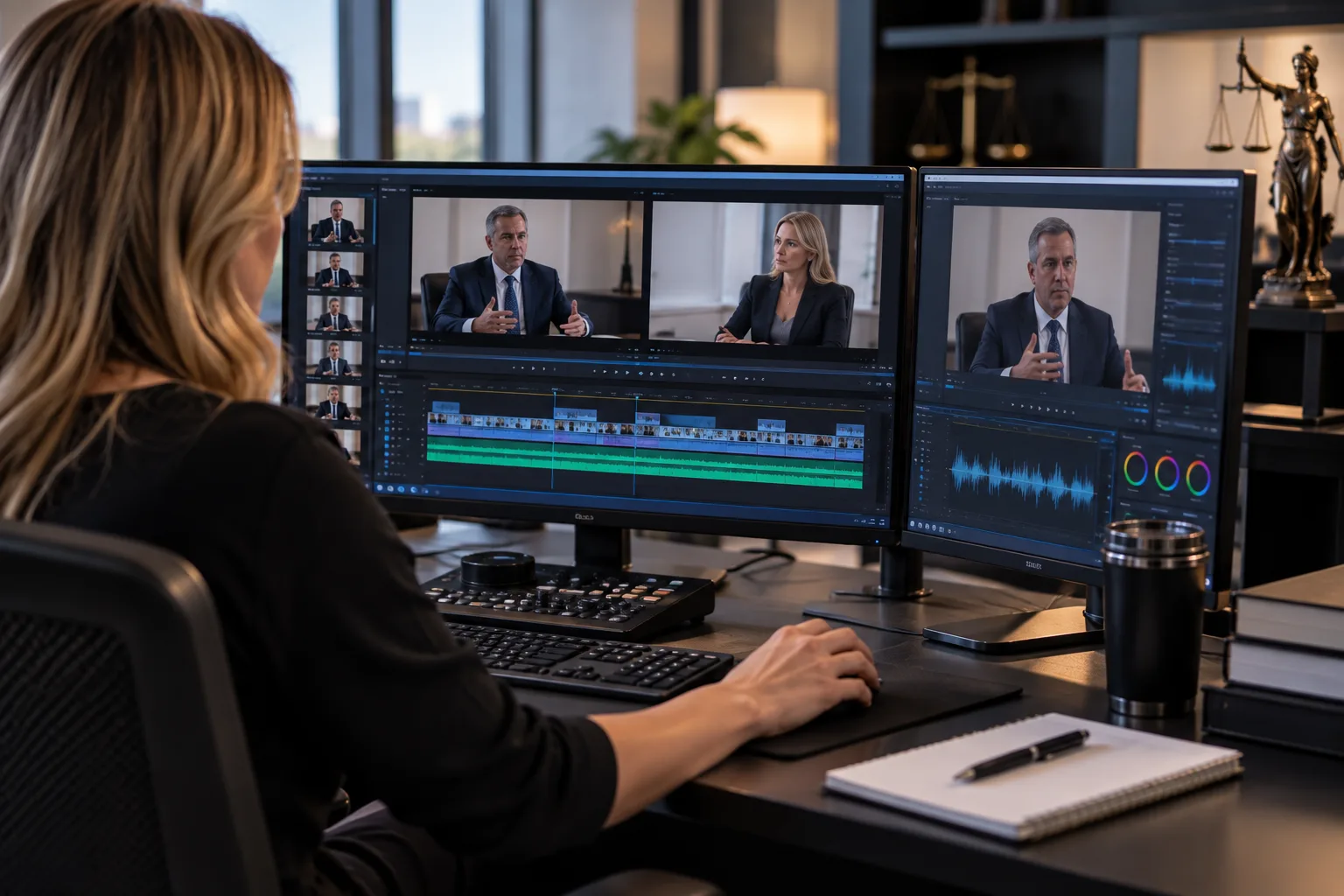
The New Standard for Remote Depositions
A distributed remote deposition succeeds through a deliberately designed, defensible record—from authority and roles to exhibits, capture, interruption response, and verified delivery—not a platform choice alone.
Deposition Practice
The question is no longer whether testimony happens on a platform or in a room. It is whether counsel has deliberately designed a record that participants can use, the officer can administer, and the team can verify after the session ends.
Remote deposition practice is mature enough to retire a false choice. The relevant comparison is not remote versus in person, and it is not one meeting platform versus another. A deposition can be orderly, fair, and reviewable with participants in several locations; it can also be fragile when everyone is in the same building. The standard is the record.
That standard begins before anyone joins a link. Authority for the format is resolved. The people in the proceeding have defined roles. Every necessary participant can see, hear, communicate, and use exhibits. Testimony and any authorized media are captured without distortion. The group knows how to handle an interruption. The final transcript, video, exhibits, and delivery path are checked rather than assumed. Those are not cosmetic production preferences. Together, they are a practical way to protect the usefulness and defensibility of testimony.
Federal practice supplies a useful legal frame, but it is not a complete remote-deposition manual. Federal Rule of Civil Procedure 30(b)(4) permits a deposition by telephone or other remote means when the parties stipulate or the court orders it on motion. Unless the court orders otherwise, Rule 29 permits stipulations about specified deposition and discovery procedures, subject to its limits. Rule 28 identifies who may take a deposition: within the United States, that generally includes an officer authorized to administer oaths by federal law or by the law where the examination is held, or a person appointed by the court; it also contains distinct provisions for depositions in a foreign country. Local rules, a case-management order, state law, an officer's requirements, and the facts of the assignment may matter as well. Counsel should identify the authorities that actually govern the matter rather than treat a familiar platform workflow as a rule.
Redefine “remote” around the record
“Remote” describes distance, not quality. It says little about whether the witness can hear a question, whether the reporter can identify speakers, whether an interpreter can work effectively, whether opposing counsel can inspect the same exhibit, or whether the final media corresponds to the testimony. Those questions are the ones that persist when locations change.
For counsel, the record-centered approach improves both planning and evaluation. It moves the intake conversation beyond a binary format selection and toward a set of decisions: Who must be present? Who has procedural authority? What is the agreed method of recording? How will exhibits be marked, displayed, transmitted, and retained? How will a dropped connection be noticed and addressed? What will be delivered, to whom, and how will the team confirm it is complete?
This does not mean every deposition needs an elaborate production plan. Proportionality matters. A short, single-witness examination with no exhibits creates different operational needs from a multi-party session involving interpreters, confidential materials, or simultaneous video recording. The discipline is scalable: resolve the matters that could affect the record, then document the agreed path at a level appropriate to the proceeding.
This is a guide to distributed remote testimony, not a room-design protocol for a hybrid deposition. Where some participants gather in person while others join remotely, physical sightlines, microphones, camera coverage, and handling of paper or physical exhibits introduce additional questions. Address those facts in the governing protocol rather than assuming that advice for an all-remote session answers them.
Begin with authority, not technology
The first question is procedural: what authorizes this format and this method? Under Rule 30(b)(4), remote means require party stipulation or a court order on motion. The rule also provides that, for purposes of Rules 37(a)(2) and 45(d), the deposition takes place where the deponent answers the questions. That location rule is specific; it should not be used as a shortcut around separate questions concerning the officer, oath administration, notice, subpoena practice, confidentiality, or applicable state requirements.
Rule 29 gives parties meaningful room to stipulate about deposition procedures, including the time and place of taking a deposition, notice, and other procedures governing or limiting discovery. The rule operates unless the court orders otherwise, and court approval is required for a stipulation extending a discovery-related time if it would interfere with a time set by the court for completing discovery, hearing a motion, or trial. In practical terms, a sound stipulation or protocol can clarify the remote means, attendance, recording, exhibit method, communications, and contingencies. It should not promise what the governing forum has not allowed.
Rule 28 belongs in the opening conversation too. Unless the parties stipulate otherwise, Rule 30(b)(5) requires the officer to begin an oral deposition with an on-the-record statement of the officer’s name and business address, the date, time, and place of the deposition, the deponent’s name, the administration of the oath or affirmation, and the identities of all persons present. If testimony is recorded nonstenographically, the officer must repeat specified information at the beginning of each unit of recorded media. Coordinate with the officer early on the planned arrangement; do not assume a software feature answers an authorization question.
Make the governing choices visible
Send the operative order, stipulation, notice, and any agreed protocol to the people who need them before the session. Identify one attorney or other authorized legal-team contact for procedural decisions. The provider, reporter, videographer, interpreter, host, and exhibit manager can execute assigned operational tasks, but counsel and the officer should not be left to infer who may decide whether to continue after a material problem.
That distinction prevents a common error: treating an operational adjustment as self-executing. Switching platforms, changing an exhibit channel, adding an observer, moving a participant into a shared room, or proceeding after a prolonged outage may have legal or strategic implications. Raise the issue, preserve the relevant facts, and obtain the appropriate direction. Production personnel should not be asked to make procedural calls on the parties’ behalf.
Assign the room before opening it
A virtual deposition room has more functions than a physical conference room makes obvious. The examining attorney, defending attorney, witness, officer, reporter, videographer, interpreter, exhibit manager, technical host, party representative, and observer may each need a distinct communication path. Ambiguity becomes costly when an unexpected person appears, a witness cannot hear, a confidential exhibit is about to be displayed, or two people speak at once.
Use a roster that lists the participant, role, location when relevant, contact method, and authorized function. Confirm in advance who admits attendees, who manages participant permissions, who presents and marks exhibits, who watches the waiting room, and who alerts counsel to a technical issue. This is not a requirement of the Federal Rules in every case; it is a production recommendation that gives the legal process a reliable operational structure.
- Counsel and the officer: resolve legal, procedural, and on-the-record questions under the governing authority.
- The reporter and videographer: perform their respective record and capture functions under the agreed method and applicable requirements.
- The exhibit manager: controls the agreed display and distribution path and identifies when a marked exhibit is available.
- The interpreter: works through a tested audio and visual arrangement appropriate to the assignment; interpreting is not merely another participant audio feed.
- The technical host: manages the assigned access and support functions and escalates rather than decides legal questions.
Roles should be especially clear where a participant needs an accommodation or interpretation. The responsible legal team should follow the controlling court, agency, contractual, or other applicable process. Do not assume that automated captions are an equivalent substitute for a requested or ordered service. Confirm the effective live communication route, how a participant signals a missed exchange, and whether a pause is needed to restore access.
Design for shared use, not passive viewing
A participant who can watch but cannot reliably hear, speak, review an exhibit, or signal a problem is not fully equipped to participate. The standard is functional access to the proceeding. Test the exact route each essential participant will use: invitation, authentication, audio input and output, camera if needed, display, exhibit channel, interpreter arrangement, and backup contact method. A generic platform demonstration is not a substitute for an assignment-specific check.
Audio deserves first attention. Clear video cannot cure an unintelligible answer. Ask participants to use a stable connection and a quiet, private setting consistent with the matter’s confidentiality needs; test microphones in the actual environment; and establish one-speaker-at-a-time expectations. A witness should answer verbally rather than by gesture, and a participant who cannot hear or understand should say so. These are record-clarity practices, not instructions about the substance of testimony.
Visual information matters as well. Verify that the witness can see the questioner when that is part of the agreed setup and, more importantly, can use the exhibit being discussed. For a participant who is blind or has low vision, an accessible equivalent, verbal identification or description, or another arrangement may be necessary depending on the governing process and the material at issue. The aim is not to narrate every visual detail. It is to make the evidentiary proposition being used in questioning available through an appropriate path.
Exhibits need one source of truth
Exhibit friction is rarely solved by opening more channels. Before the deposition, decide who marks an exhibit, what identifier will be used, how the witness receives it, whether it is displayed by screen share or distributed through a controlled repository, how confidential material will be handled, and how the final exhibit set will be preserved. Tell participants what to do if a page does not render, a document is incomplete, or a physical object must be shown.
When an exhibit is introduced, identify it on the record and give participants reasonable confirmation that they have the correct material before substantive questioning proceeds. Avoid relying on an unannounced screen share as the only way a witness receives a document. If a paper exhibit, demonstrative, or physical item is used from a room, plan a method for remote participants to inspect the relevant content. This article does not prescribe a mixed-room setup; when some participants gather physically and others join remotely, the detailed room, camera, microphone, and physical-exhibit protocol should be separately planned.
Capture testimony without adding distortion
Rule 30(b)(3) requires the party noticing an oral deposition to state the method for recording testimony. Unless the court orders otherwise, testimony may be recorded by audio, audiovisual, or stenographic means, and the noticing party bears the recording costs. Any party may arrange to transcribe the deposition. Another party may designate an additional method with prior notice to the deponent and other parties and bears the expense of that additional record or transcript unless the court orders otherwise. The notice, stipulation, and assignment instructions should align on what is being captured and by whom.
Rule 30(b)(5) provides a critical guardrail: the appearance or demeanor of the deponent or any attorney must not be distorted through recording techniques. Treat that as more than a post-production concern. Avoid filters, effects, selective framing, artificial backgrounds that interfere with the face or relevant visual information, or audio processing that changes how testimony is conveyed. Use stable, ordinary framing and intelligible audio. If the planned setup cannot produce them, solve the setup problem rather than attempting to repair a compromised record later.
Legal videography and the stenographic transcript serve different functions and should not be casually conflated. A video file does not itself become a certified transcript; a transcript does not automatically establish that video and text are synchronized. When synchronized video is requested for review or later use, preserve the authoritative transcript and identify the transcript version used for synchronization. Check synchronization against the final media, including speaker changes, interruptions, and any recording-unit boundaries. Any editing, clipping, or use at a later proceeding remains subject to the applicable rules, orders, and evidentiary rulings.
Agree on interruption rules while everyone is calm
Every proceeding can be interrupted. Remote proceedings simply make some interruptions more visible: unstable bandwidth, failed audio, a participant who reconnects, an exhibit permission problem, a lost interpretation channel, or an uninvited attendee. A defensible process is not one that promises no disruption. It is one that makes a disruption observable, gives the right people a path to respond, and leaves a clear account of what happened.
Before testimony, agree on a simple protocol: how a participant signals a problem; who receives that signal; who may call for an operational pause; who has authority to decide whether testimony continues; how participants reconnect; and how a material gap is placed on the record. A separate phone, email, or text channel for technical escalation can be useful, but it should not become a concealed merits conversation. Counsel should respect applicable rules and orders governing communications with a witness during testimony.
| Element | Question to resolve | Evidence of readiness |
|---|---|---|
| Authority | What stipulation, order, notice, and officer requirements control? | Current documents and decision contact are identified. |
| Participation | Can every essential participant hear, speak, see what is necessary, and signal a problem? | Event-specific connection and access checks are complete. |
| Exhibits | How will material be marked, displayed, received, and preserved? | One agreed workflow and a fallback path are communicated. |
| Capture | What recording methods are noticed or authorized, and who operates them? | Capture roles and an on-record opening plan are confirmed. |
| Interruptions | What happens when communication, access, or attendance changes? | Signal, pause, escalation, and reconnection steps are known. |
| Delivery | Which final record components go to which recipients? | File list, access method, and acceptance checks are defined. |
Finish with verified deliverables
The deposition does not end when the meeting window closes. The final handoff may include the official transcript, video recording, exhibits, a synchronized transcript-video product if requested, and any other agreed material. Each has a distinct role. Define the required files, formats, naming convention, recipients, delivery channel, security controls, retention expectations, and any deadline before the session whenever possible.
Verification is a final record-protection step. Confirm that the delivered video opens and runs through its expected duration; that audio is intelligible; that the correct transcript and exhibit set are associated with the proceeding; that synchronization, if supplied, matches the identified transcript version; and that authorized recipients can use the delivery route. Preserve the original capture and related materials in accordance with the matter’s preservation obligations and applicable protective order or confidentiality requirements. Do not confuse convenient hosted access with a complete preservation plan.
For counsel evaluating a legal videography, transcript-synchronization, interpreting, exhibit-support, or delivery provider, the most useful questions are concrete. Ask how roles and escalation are handled; how capture methods are documented; how an interpreter or access arrangement is supported; how exhibits are tracked; what final deliverables are included; and what verification occurs before release. The answer should describe a process, not merely a platform feature.
The new standard is disciplined design
Excellent remote deposition practice is memorable precisely because it is uneventful. Participants know their roles. The witness can answer, the reporter can make the record, counsel can use exhibits, an interpreter can perform the assigned function, and a technical issue produces a known response rather than improvisation. The final materials arrive as the team expected and can be checked against what occurred.
That is a higher and more durable standard than asking whether the deposition was remote. It respects the legal framework, preserves the officer’s and counsel’s respective roles, and recognizes that a record is made through people, process, and tools working together. Start with the proceeding. Design for the record. Verify the handoff.
Sources and further reading
- U.S. Courts, Federal Rules of Civil Procedure — official current rules page for civil proceedings in United States district courts.
- U.S. Courts, Federal Rules of Civil Procedure (December 1, 2025 PDF) — official text of Rules 28, 29, and 30, including officer, stipulation, remote-means, notice, recording, and officer-opening provisions.
- U.S. Courts, Current Rules of Practice and Procedure — official access point for the current federal rules and related materials.